Position
Choose a narrow offer, customer, and NAICS lane.
FOR BEGINNERS WHO WANT A REAL OPERATING PLAN
The practical 2026 field guide for turning SAM.gov, NAICS codes, capability statements, subcontractors, pricing, and proposal requirements into one disciplined first-pursuit process.
REGISTRATION IS ONLY THE ENTRY TICKET
Choose a narrow offer, customer, and NAICS lane.
Build searches around actual buying patterns.
Run bid / no-bid before spending proposal time.
Price, partner, write, submit, and learn.
The goal is not to collect every opportunity. It is to leave your first 30 days with a focused capability statement, a qualified pipeline, credible partner conversations, and at least one response moving for the right reasons.
WHAT YOU WILL LEARN
Choose a focused service, beachhead customer, and proof story before you chase notices.
Understand SAM.gov, UEI, CAGE, renewal prep, and the data you should gather first.
Use classifications and eligibility as decision tools - not as a substitute for capability.
Create saved searches around buyer language, notice types, timing, and real buying patterns.
Turn broad claims into a focused one-page proof document with a useful next step.
Choose a responsible delivery route and vet partners before making commitments.
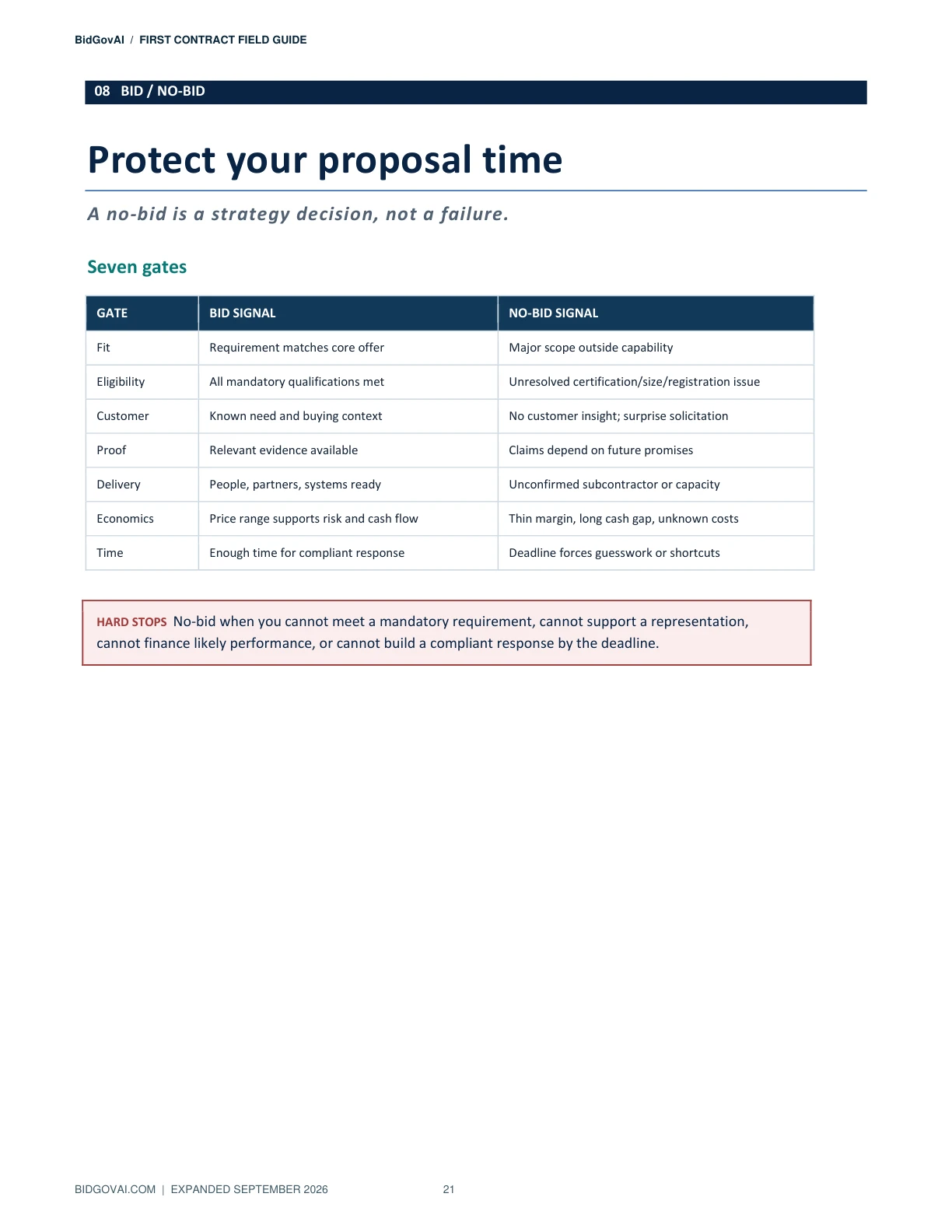
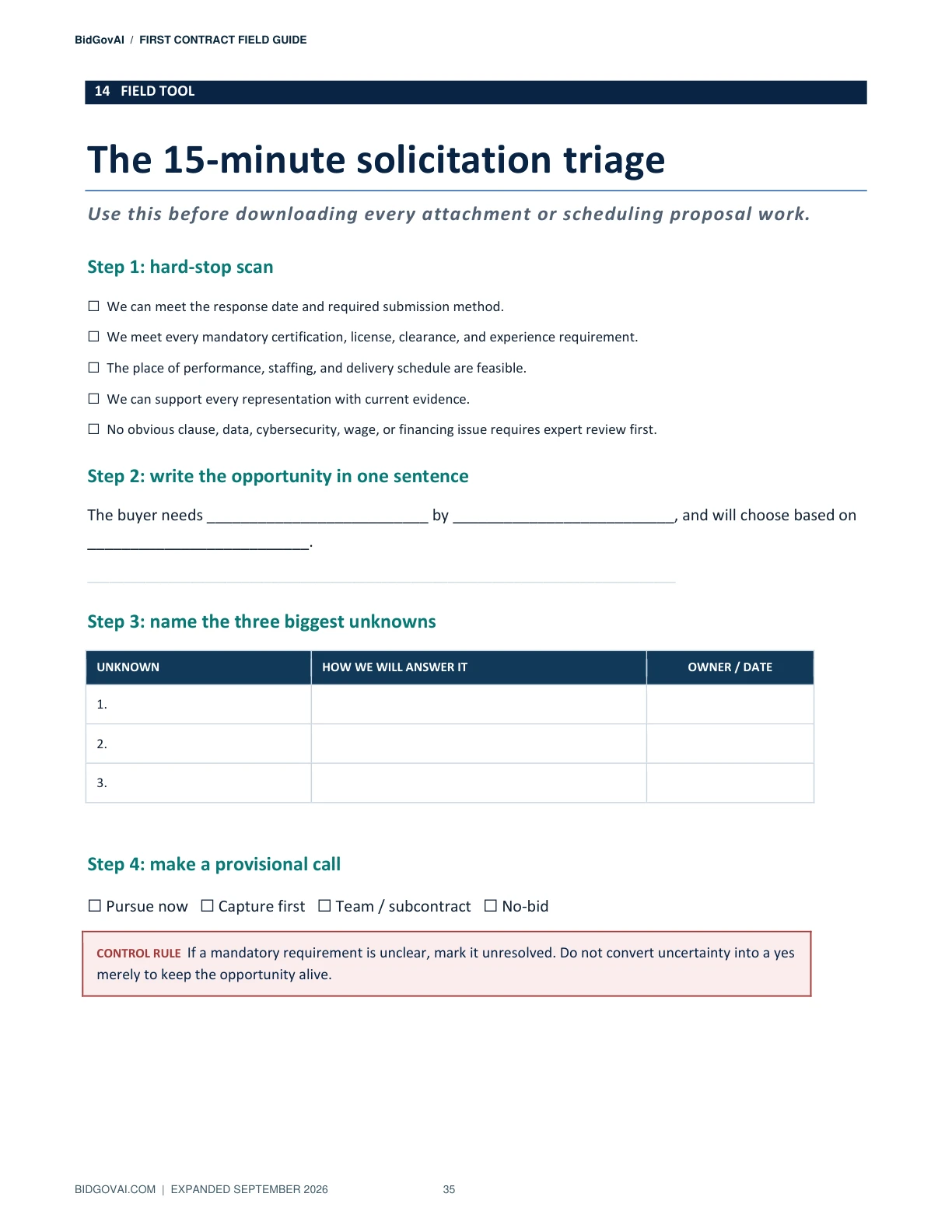
Score fit, eligibility, proof, delivery, economics, and time before proposal work begins.
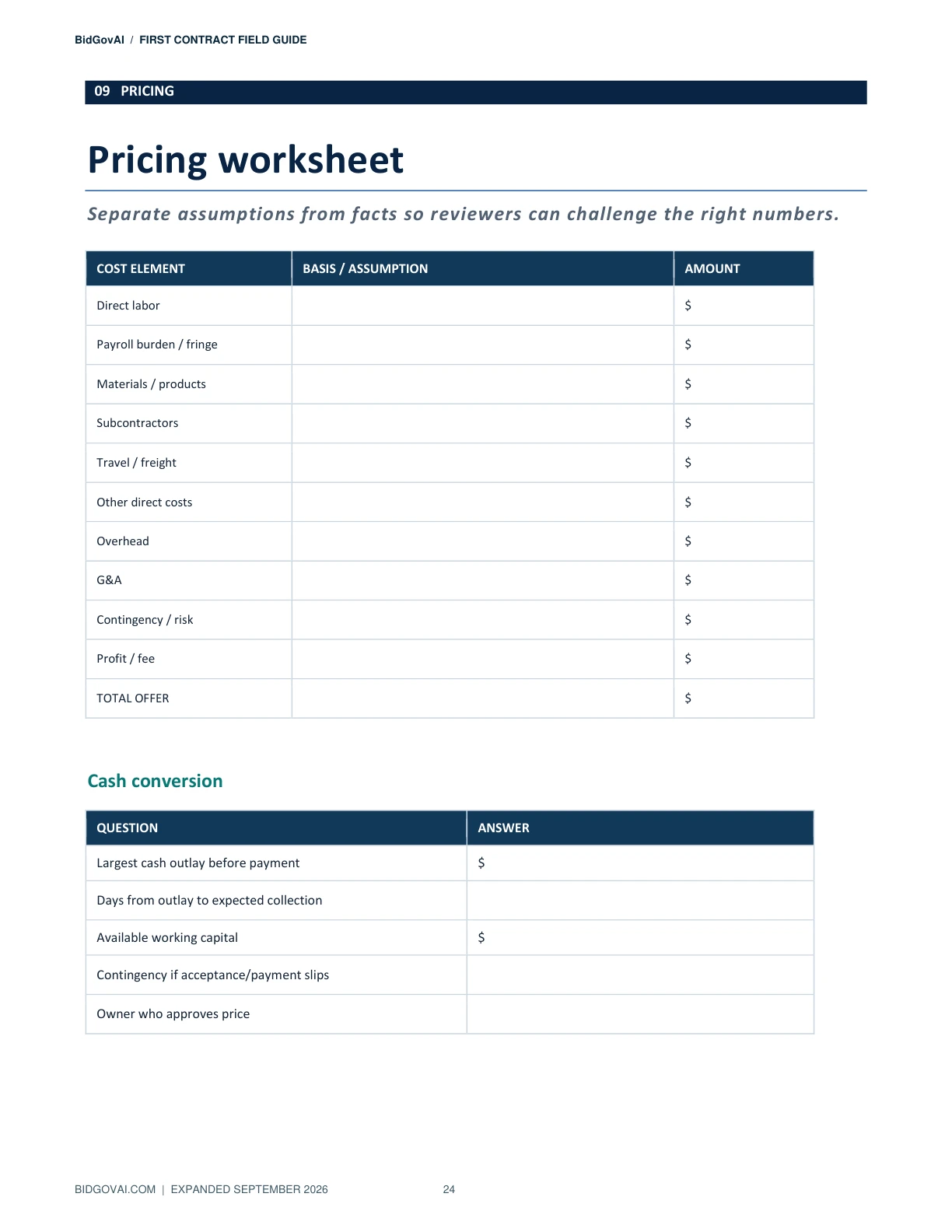
Build a bottom-up price, cash-flow test, compliance matrix, and 30-day action cadence.
REAL PAGES. REAL WORK.
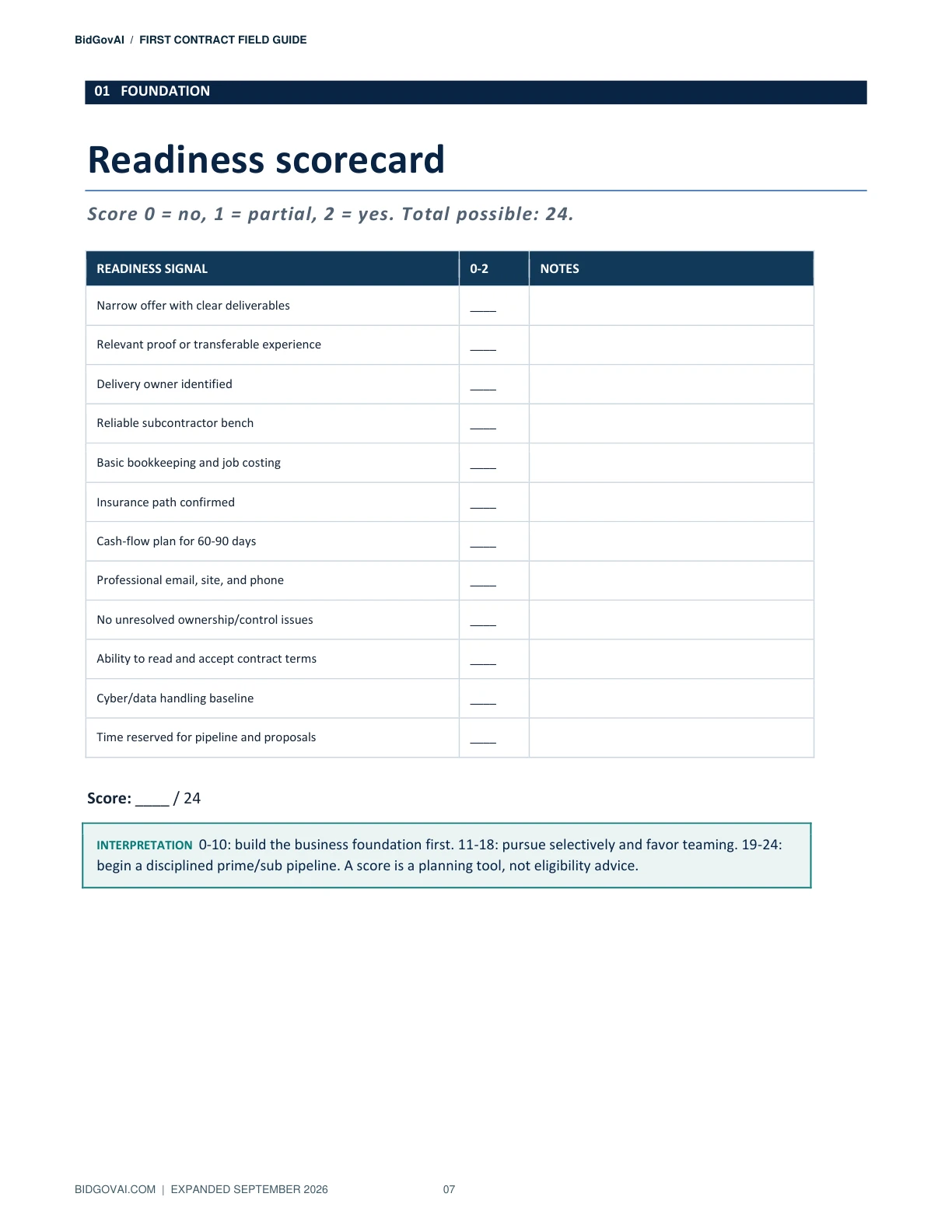
The guide gives you decision tools, not filler. Print the worksheets or work through them on screen as you build your first real pipeline.
THE WORKBOOK ADVANTAGE
Each tool is built to create something useful: a decision, a worksheet, a partner conversation, a search rule, or a buyer-ready asset.
WHAT YOUR $27 ACTUALLY BUYS
Every section is designed to help you complete a business decision or asset. The value is in the sequence: each piece prepares you for the next.
Score your starting point, prepare SAM.gov details, and understand where UEI and CAGE fit.
Choose a practical service lane, map likely buyers, and build searches around real procurement language.
Shape a buyer-ready capability statement and vet subcontractors before you depend on their pricing or performance.
Use weighted decision gates and hard stops before an opportunity consumes your calendar.
Separate direct cost, overhead, risk, profit, and cash exposure before you submit a number.
Turn the solicitation into a compliance matrix and move through one practical action each day.
A DAY-BY-DAY STARTING POINT
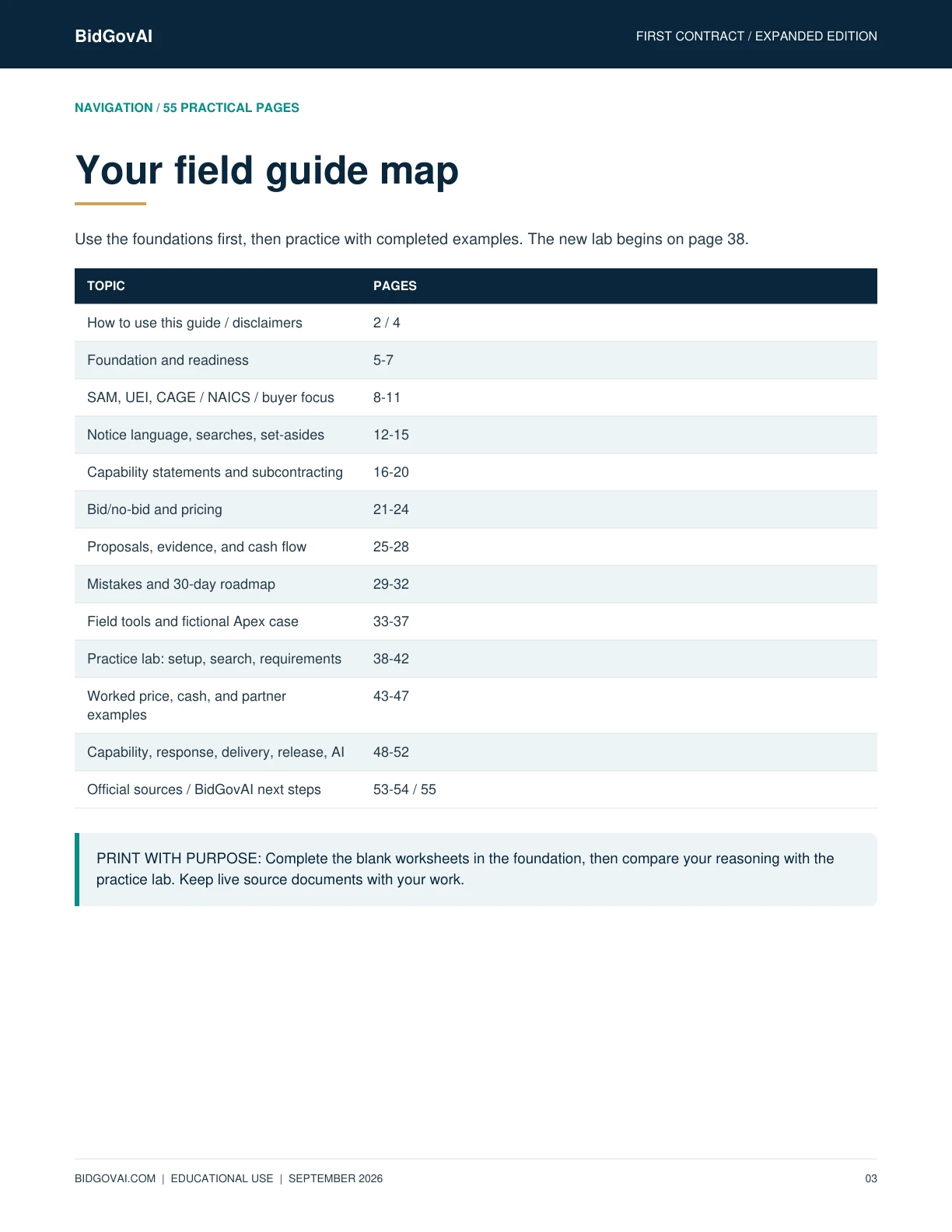
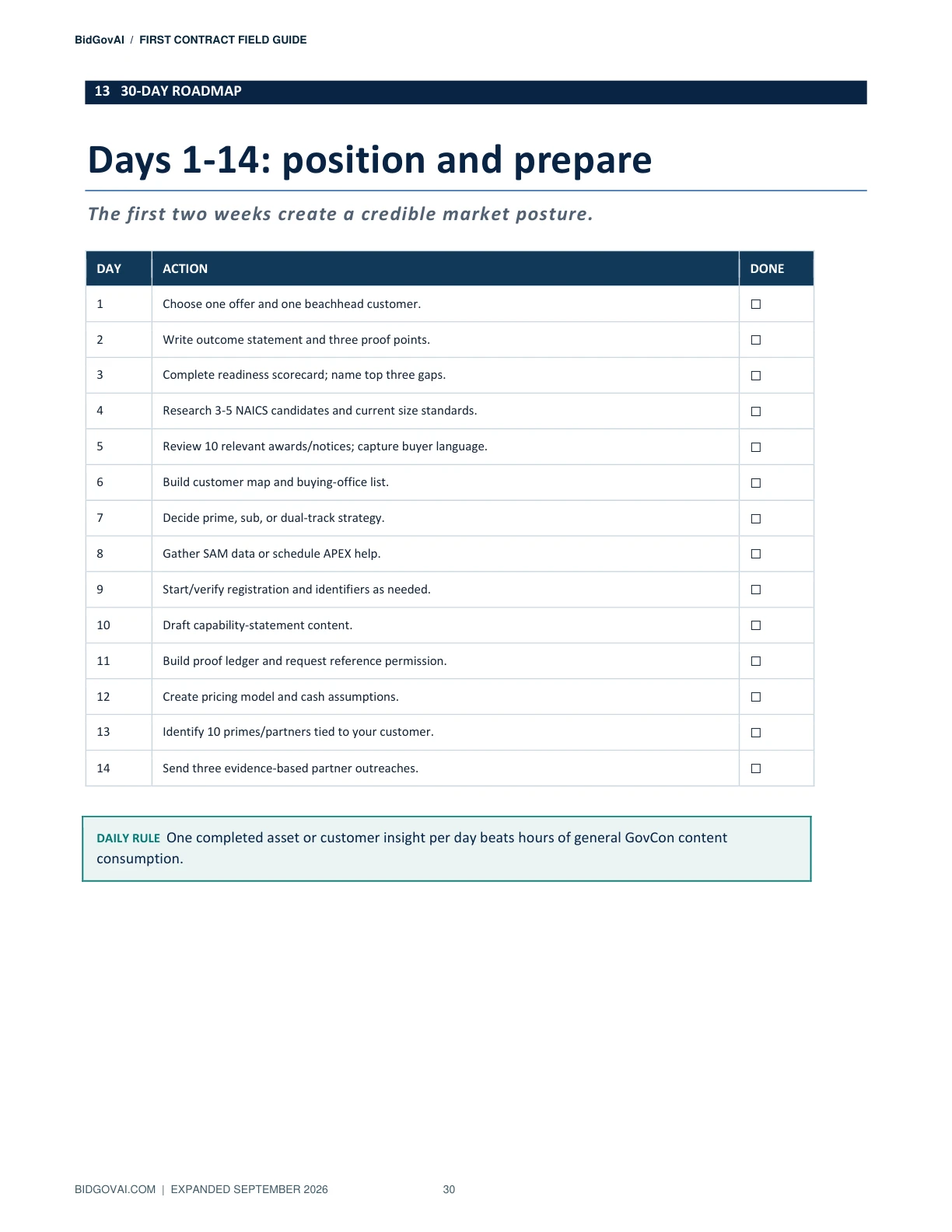
Move through positioning, registration preparation, market research, partner outreach, opportunity qualification, pricing, and your first response cycle in the right order.
One completed asset or customer insight per day beats hours of general GovCon content consumption.
THE “MIDDLEMAN” QUESTION - ANSWERED RESPONSIBLY
You remain responsible for delivery, quality, schedule, invoicing, compliance, and subcontractor management.
Define roles, commitments, pricing, evidence, and backup plans before putting a partner in your response.
Approach relevant primes with a specific deliverable, capacity, geography, and risk-reducing proof.
A no-bid is a strategy decision when eligibility, proof, capacity, cash, or timing does not support a credible path.
WHY THIS GUIDE IS DIFFERENT
BidGovAI does not promise that contracting is effortless. The guide shows you how to reduce preventable mistakes, make responsible commitments, and know when an opportunity deserves your time.
THIS GUIDE IS FOR YOU IF...
ONE SMALL PURCHASE. ONE CLEAR NEXT MOVE.
THE FIRST CONTRACT FIELD GUIDE
Get the full 2026 PDF workbook with 44 focused pages, practical checklists, worksheets, outreach scripts, official-source links, and a complete 30-day action roadmap.
QUESTIONS BEFORE YOU BUY
Federal contracting is the main frame, but the positioning, opportunity qualification, capability, pricing, subcontracting, and pipeline disciplines also apply to many state and local pursuits. Always verify the rules of the specific buyer.
No. The guide intentionally starts with your offer, customer, proof, and readiness. It then walks through SAM.gov, UEI, and CAGE so you can prepare accurately instead of treating registration as the whole strategy.
Yes. It explains prime versus subcontract roles, partner due diligence, outreach, and limitations on subcontracting. It is clear that a prime contractor cannot be passive and remains accountable for compliant performance.
No. No legitimate guide can guarantee eligibility, an award, profitability, or payment timing. This guide helps you make better pursuit decisions, build credible assets, and avoid preventable beginner mistakes.
The paid product is a polished 44-page PDF workbook designed for reading, printing, and completing alongside your first pursuit cycle.
No. It is educational information. The live solicitation, amendments, incorporated clauses, official systems, and written agency instructions control. The guide includes a full disclaimer and official-source page.